Let’s talk ears, piercings, and the tools that help us add that perfect little sparkle! Ear...
Ear Lobe Piercing: Needle vs. Piercing Gun
What Does the Research Actually Show?
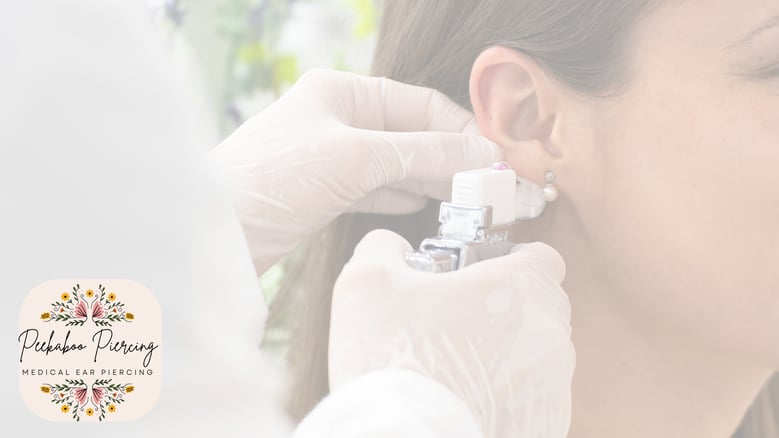
*The following information is for the lower portion of the earlobes only*
Piercing Needle or Gun? Key Findings: No Difference in Tissue Trauma
A histologic study on fresh human cadaver ears directly compared spring-loaded piercing guns (Caflon, Blomdahl), a hand-force system (Studex), and a 16-gauge hollow piercing needle.
The results were clear:
No significant difference in the amount of injury between the different piercing techniques was observed.
All methods produced the same pattern of injury — perichondrium stripping from cartilage around the pin tract, with most damage at the exit site. Cartilage fractures and loose fragments were present to the same extent regardless of technique.
Bottom line: There is no clinical evidence that a needle causes less tissue damage than a piercing gun for earlobe piercing.
What Does It Matter For Safe Ear Lobe Piercing?
Since the technique itself does not determine tissue trauma, the following factors are what
truly influence outcomes:
1. Sterilization Hygiene
- Equipment must be properly sterilized between uses
- Single-use, disposable components are preferred
- Universal precautions against blood-borne infections should be followed (per CDC and AAD recommendations)
- Practitioners should use medical-grade protective gloves
2. Practitioner Training
- Personnel should be trained in sanitation, sterilization, cutaneous anatomy, and wound care
- Improper technique — regardless of the tool used — increases the risk of complications such as embedded earrings, infection, and scarring
3. Appropriate Jewelry
- Use only: surgical-grade stainless steel, titanium, niobium, or 14/18 karat gold
- Avoid: brass, nickel-containing alloys (risk of allergic contact dermatitis)
- Jewelry must be appropriate in length and width to accommodate post-piercing swelling
4. Aftercare
- Clean the piercing site gently with saline solution twice daily
- Avoid touching the piercing with unwashed hands
- Do not remove or rotate jewelry during the healing period
- Healing time for earlobes: approximately 6–8 weeks
Gun vs. Needle: Earlobe Piercing Complication Rates
- Overall complication rate for earlobe piercings: approximately 25%
- Infection rate for earlobe piercings: approximately 24%
- Severe complications in the ear region: below 1%
- Most common pathogens: Staphylococcus aureus, Group A Streptococcus, Pseudomonas species
These complication rates are related to hygiene, aftercare, and practitioner skill — not the piercing tool itself.
Important Note: Piercing Cartilage is a Different Ballgame
The above applies to earlobe (soft tissue) piercing only. Cartilage piercings carry significantly higher risks:
- Complication rate: 40% (vs. 25% for earlobes)
- Infection rate: 30% (vs. 24% for earlobes)
- Higher risk of perichondritis and Pseudomonas infection
- Cartilage piercings may require different clinical considerations
When to Seek Medical Care for Needle or Gun Piercing
Seek care promptly for:
- Persistent drainage of pus or blood lasting more than 14 days
- Increasing redness, swelling, or warmth spreading beyond the piercing site
- Fever or chills
- An earring backing that appears embedded in the earlobe
✓ Research shows no difference in tissue trauma between needle and piercing gun for earlobe piercing
✓ Safe outcomes depend on sterilization, practitioner training, jewelry quality, and
aftercare — not the tool
✓ Both techniques are acceptable for earlobe piercing when performed with proper hygiene
and technique
✓ Informed consent and post-procedure wound care instructions should always be provided
Sources:
Based on current peer-reviewed evidence and the American Academy of Dermatology Position Statement on Body Piercing (revised 2022).
Ear Piercing Techniques and Their Effect on Cartilage, a Histologic Study.
Journal of Plastic, Reconstructive & ; Aesthetic Surgery : JPRAS. 2007. van Wijk MP, Kummer JA, Kon M.